
Using pXRF To Assess the Efficacy of Three Treatments to Remove Toxic Heavy Metals from the Surface of Fire-Damaged Objects
Presentation authors: Catherine Sincich and Vanessa Muros
Blogpost Summary by Hannah Stahulak, Silverlake Conservation
Catherine Sincich and Vanessa Muros gave a thoughtful presentation about their experiences and discoveries at the Altadena Library Fire Clinic after the Eaton Fire. While cleaning objects at this clinic, Sincich and Muros were curious about the known heavy metals commonly encountered after a wildfire, and how effective current conservation cleaning methods are at reducing these toxic heavy metals.
The presentation focused on five toxic heavy metals that can be exposed in objects after a wildfire; those metals being arsenic, lead, mercury, chromium, and cadmium. These metals can bioaccumulate in the body, therefore Sincich and Muros were curious to test conservation cleaning methods to see if what conservators do actually reduces the amount of heavy metals present. Sincich and Muros had six identical silverplated spoons that survived the Eaton Fire that worked as a controlled variable while testing various cleaning methods. They decided to focus on three cleaning methods: soot sponging, ultrasonic cleaning, and electrolytic reduction (E.R.). The results before and after cleaning were examined with a Portable XRF Spectrometer (pXRF) which helps to detect the presence and relative amounts of elements on the surface of an object by picking up on each element's unique wavelength. Each object was scanned before treatment with the pXRF Spectrometer and it was found that while the top five toxic heavy metals were not present, other heavy metals were.
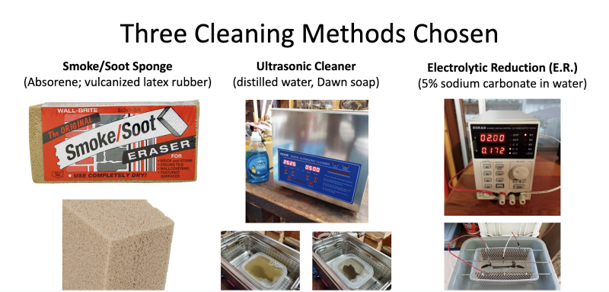
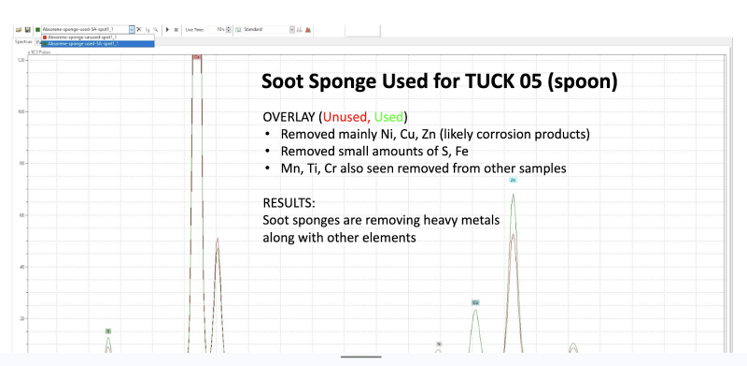
The first test performed on the spoons was dry cleaning with a soot sponge, which is made of vulcanized latex rubber. Sincich and Muros found that the soot sponges were useful in removing metals such as copper, nickel, zinc, and iron, and even picked up trace amounts of elements such as sulfur, titanium, manganese, and chromium. This proved that the sponges are effective in cleaning corrosion products off of fire damaged surfaces.
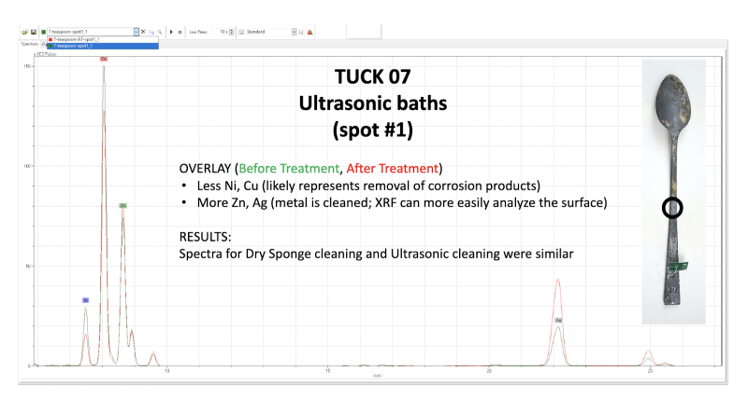
The next test was an ultrasonic bath, which lasted five minutes and used distilled water and Dawn dish soap to create the bath. After the ultrasonic bath the spoons were tested with the pXRF Spectrometer and found very similar results to the soot sponges, the bath removed corrosive metals and was therefore effective.
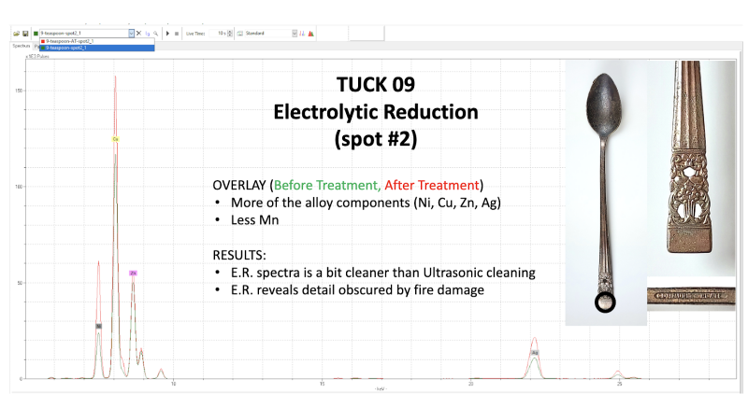
The last test performed was the Electrolytic Reduction (E.R.) which used five percent sodium carbonate in water. The pXRF Spectrometer showed us that E.R. was effective in reducing metals, especially alloy components such as nickel, copper, zinc, and silver. The E.R. cleaning also revealed details of the spoon that were covered by fire damage prior to testing.
The conclusion of these findings is that all three methods are useful in reducing heavy metals present in fire damaged objects. Soot sponges are excellent for dry cleaning and conservators can continue to use them with confidence. Ultrasonic baths are a great tool for wet cleaning. And E.R. stabilizes metal objects by reducing the oxidation state and removing unwanted substances. Sincich and Muros ended by hoping to continue this study and look at the presence and persistence of toxic heavy metals from houses that survived the wildfires versus houses that burned. I look forward to hearing their continued findings.