
The Uncloaking and Destruction of a Mural at the Pasadena Jewish Temple Center
Presentation authors: Brandon Phoung, Kiernan Graves and Margalit Schindler
Blogpost Summary by Shannon Trono, Graduate Intern at Getty Conservation Institute 2025-2026
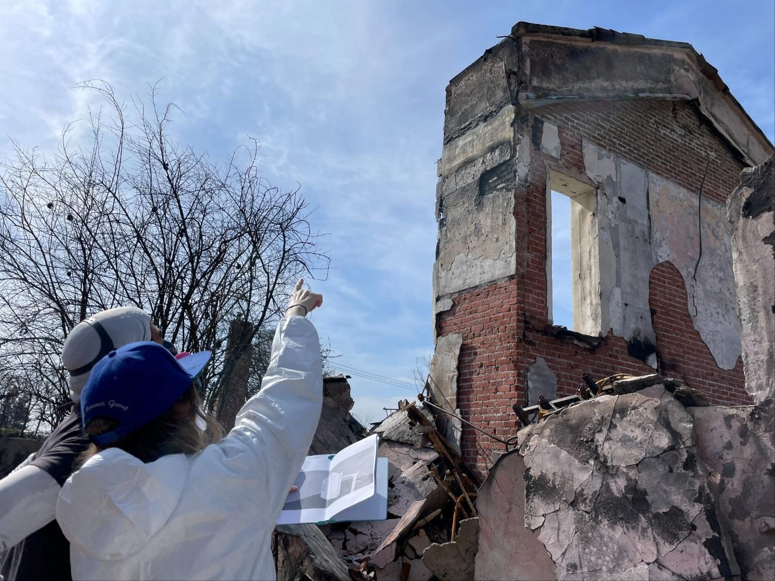
During the Eaton Fire, widespread destruction at the Pasadena Jewish Temple Center revealed an unexpected discovery: a previously unknown mural concealed beneath plaster on a surviving two-story brick wall. As much of the Center’s three buildings were lost, this lone double-brick wall—with painted surface exposed on its upper story—remained standing. Revealed unexpectedly by the fire, the mural was documented and fragments were recovered to allow for potential future study or conservation.
Brandon Phoung presented his role in the emergency stabilization effort, working alongside Kiernan Graves (Site and Studio Conservation) and Margalit Schindler (Pearl Preservation, LLC). With heavy rain forecasted and long-term decisions still pending, the immediate priorities were to record the mural and protect it from further environmental exposure. To this end, Alan White (AQYER, LLC) conducted 3D laser scanning of the wall, providing a detailed digital record of both the mural and the wall’s architectural features. This documentation informed the design of the protective enclosure and preserves a record of the mural before intervention.
Access and site conditions posed significant constraints. Surrounded by debris, the wall could only be reached via an 80-foot boom lift. With limited time and no confirmed funding, Phoung designed a low-cost, non-invasive protective enclosure using Tyvek, PET foam gasketing, sandbags, and salvaged materials. The wall’s geometry—including two returns and a gable peak—required a custom transition to create a tensioned, weather-resistant envelope. Surface preparation involved grinding down protrusions to prevent punctures, and percussive tools were avoided due to concerns about structural instability. Installation was completed in a single day, extending into darkness.
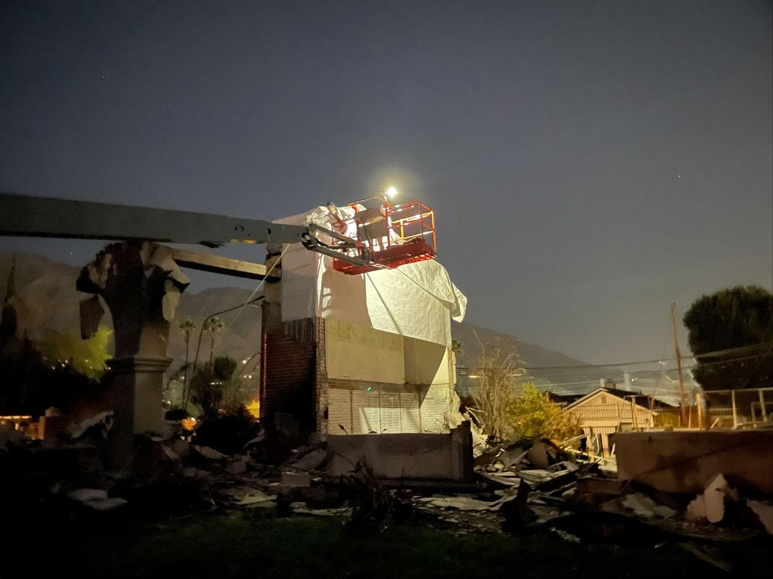
Ultimately, despite the rapid stabilization efforts, the surviving wall was scheduled for demolition as part of FEMA’s post-fire land-clearing process. The team worked quickly to recover fragments of the mural where possible, preserving them for future assessment or treatment once funding or additional support can be secured. While the mural could not be preserved in situ, this effort highlights the careful balance between emergency conservation, regulatory requirements, and planning for long-term stewardship. It stands as a testament to the ambition and creativity required to protect cultural significance in the aftermath of disaster, even when permanent preservation of the site is not feasible.